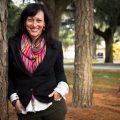
I DON’T always cry on the job, but when I do, it’s a several-tissue situation.
People think this writing business requires a steady hand and a stone cold heart, but I’m living proof that it can be done with smeared mascara and a lot of snot.
Sometimes talking about hard things is just hard. When I’m asking total strangers questions about their tragedies and challenges, I can get overwhelmed by their courage and heroics, or sometimes just by the sheer shittiness of the world we all have the fortuity to share.
I’ve sobbed sitting across from refugee families and ex-cons, triggered by the emotion-steeped telling of their own stories. I’ve blubbered with parents of sick kids and bawled at the beauty of a pristine watershed threatened by greedy developers.

I’ve made sure to keep extra Kleenex packets in my purse ever since I was a cub reporter interviewing my first big celebrity, veteran and Born on the Fourth of July author Ron Kovic, who patted my hand and sniffled along with me when I burst into tears as he was describing how his newfound love for painting had helped heal his soul.
Ron assured me that I shouldn’t be embarrassed at having an ooey-gooey marshmallow center, and that while fairness and adherence to facts were essential qualities in a writer, staying human was the most important. I took that advice to heart and have ugly-cried my way plenty through the past two decades, red nose and all (thankfully, I didn’t choose a career in live television.)
The events of the past year have reduced a lot of us to puddles on a regular basis, and I didn’t even try to keep it together when I sat down at Foxy Loxy with Mia Merlin, the organizer and curator of the 49 Portraits Project. The Pulse nightclub massacre in Orlando on June 12, 2016 may already seem like a long time ago in this surreal cycle of sick, senseless tragedies we seem stuck in, but as the first anniversary of the horror nears, I can’t help but choke up anew. The violent invasion of Pulse’s LGBT safe space remains an affront to all who believe in love, and the beautiful innocents shot down are a reminder of a world gone mad.
“It’s OK,” Mia tells me as I pretend like I have something in my eye.
“I still get upset, too.”
For her, the faces of the 49 men and women murdered that night have not faded. If anything, they’ve only become clearer: The artist and art lecturer at Armstrong State University has been looking at every dimple, eyelash and cheekbone every day for almost a year, first as pixelated Facebook and Instagram profiles and later in acrylics and oils on canvas as the 49 Portraits Project evolved from a tentative wish to a country-wide collaboration.
Inspired by New York artist Rudy Shepherd’s evocative homages to the nine victims of the Mother Emanuel AME Church 2015 shootings in Charleston, Mia (pronounced “My-ah”) wanted to memorialize the Pulse dead in a similar way as a gift for their families. The sheer number of faces to paint and the toxic slog of the election season might have crushed the idea. But after a single exploratory Facebook post, she started receiving messages from other artists clamoring to take part.
“Within a few days, I was getting emails from Washington, Texas, California,” she recalls, both of our eyes filling for the instant boomerang of support.
“It was the antidote to the poison.”
Still, the project was fraught with uncertainty at every turn: Would enough artists deliver? How would the portraits be framed and shipped? Most importantly, would the families even want them?
A Go Fund Me page quickly took care of the financial logistics, and stronger validation came from the City of Orlando when it chose to exhibit 49 Portraits in City Hall, where they have been on display since May 1 and will be distributed after June 14 to the victims’ loved ones by the Orlando United Assistance Center. In some cases, the artists painted copies so that parents and partners left behind could each have a portrait, and the curator hopes the likenesses will bring solace.
“The images were all publically shared, but we didn’t have permission, we didn’t have their blessings,” confesses Mia. “I wasn’t sure how they would be received.”
Most of the families accepted the artists’ efforts with gratitude, and in the one instance that one father didn’t like the final portrait, Mia helped facilitate communication between him and the artist that yielded a deeper understanding that changed his mind.
Last Saturday, hundreds showed up to an emotional public reception in Orlando City Hall, one of many Pulse memorials the city—and the nation—will be hosting in the coming week, in the midst of a bittersweet Pride month.
“We received more proposals than we could have ever imagined, and this show struck the right tone,” confirms Shannon Fitzgerald, Director of Public Art for the City of Orlando.
“It’s very thoughtful, very contemplative, it’s quiet but it still resonates.”

Mia traveled to Florida to meet the loved ones and artists for the first time, and a man came up who was close to many of the victims, deeply moved by how the project honored their distinct personalities .
“He said, ‘what I love the most about it is that it is about each person as an individual, and recognizing and celebrating their individuality,’” she shared afterwards.
A year after the Pulse killings, we seem to have more reasons to despair than ever as hatemongers slash more innocents and society spirals downwards towards Game of Thrones barbarism. We shed buckets of tears over how hair-tearingly unfair it is that progress towards peace can be shredded by a few psychopaths, and that our LGBT and other marginalized siblings still struggle every day for acceptance, safety and basic dignity.
However, to paraphrase Pope Francis, the only future worth building is one that includes everyone, and I keep trying to remember that the only truly useful response to violence and insanity is love. (If you need some extra, there will be a lot of love going around at the Rally for Equality this Sunday, June 11 at 2pm in Johnson Square—check the First City Network Facebook page for more information.)
Thankfully there are those who remind us, channeling compassion and generosity through skilled hands wielding brushes and paint. Art is love made manifest, and each of the artists of the 49 Portraits project have brought their whole hearts to the canvas to show us up close the souls we have lost, kindred now.
“When you paint someone, you’re loving every part of their face,” describes Mia as I open another pack of tissues.
“By the time you’re done, they’re not a stranger anymore.”
Something similar happens, I think, when we cry with each other. We humans carry so much within, hiding our vulnerability from the evils of the world, yet having our soft centers witnessed with empathy may be the only true healing there is. Even if we end up puffy-eyed, feeling the splash of tears on a table and the heat of grief fosters a familiarity that can never be replaced by clicks and memes.
My friend Ron helped me understand a long time ago that sharing our heartbreak isn’t to be ashamed of: It is what helps give us the courage to blow our noses, meet each other’s eyes and face another day.
This article appears in Jun 7-13, 2017.