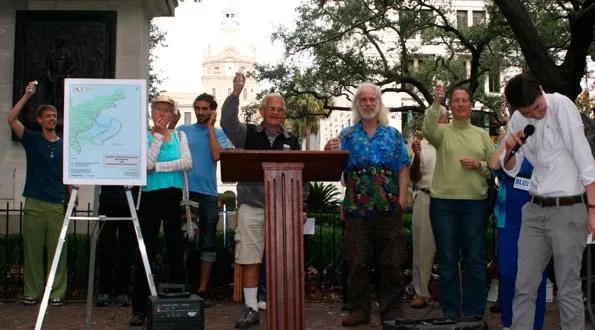
For several minutes last Tuesday, Johnson Square was the loudest spot in town.
About 20 activists wielded air horns, whistles and other noisemakers in the normally halcyon public space to demonstrate what ocean mammals hear when seismic airgun testing is used to search for underwater oil reserves.
Katie Parrish, a campaign organizer with Oceana, an environmental lobbying group based out of Washington, D.C., explained that seismic air guns are towed behind ships and shoot constant bursts of noise — twice as intense as a rocket blast — into the seafloor to create a map for oil companies.
It’s like having a jet plane fly over your head every ten seconds, 24 hours a day for days and weeks at a time,” said Parrish.
“The decibels produced by seismic airguns are loud enough to kill a human being,” she added.
They also present danger to marine wildlife. According to estimated data provided by the U.S. Dept. of the Interior, seismic airgun testing along the Atlantic Coast will harm 138,500 dolphins and whales, including the endangered North Atlantic right whales that calve off the Georgia Coast. The Dept. of the Interior is considering a proposal to employ seismic airgun testing along the Atlantic Coast from Delaware to Florida in 2013.
Earlier this year, almost 900 dead dolphins washed up along the shores of Peru after seismic airguns were used to explore possible oil and gas reserves in the Pacific Ocean. Though the Peruvian government denies that the testing caused the mysterious deaths, scientists have confirmed that many of the dolphins had fractured middle ears, an injury believed to be caused by massive sonic blasts.
Oceana is enlisting grassroots organizations to stop the federal government from using the harmful technology. Parrish was joined in Johnson Square by members of the Sierra Club, Center for a Sustainable Coast, Occupy Savannah and other local groups.
Aside from the attendant harm to marine mammals, using seismic airgun testing is poor logic, argued the protestors, citing other countries’ push towards renewable energy sources.
“Even if they find oil, it’s going to be at least ten to 15 years before they can do anything with it,” said the Sierra Club’s Steve Willis. “Are people going to be looking for more ways to put carbon in the atmosphere then? I don’t think so.”
The U.S. current offshore drilling plan doesn’t include any East Coast drilling through 2017, and studies have not shown any significant oil near the surface. And drilling deeper “is just using danger to cause more danger,” according to David Kyler of Center for a Sustainable Coast.
“We all know what can happen with that,” he warned, referring to BP’s Deepwater Horizon spill that decimated the Gulf Coast in 2010.
Kyler pointed out that many countries have backed away from oil, notably Germany, which already counts 25 percent of its energy from wind, solar, geothermal and other renewables. Germany plans to net 80 percent of its electricity from those sources by 2050.
“Why are we continuing to use obsolete technology with all these environmental burdens?” Kyler challenged the small crowd, which returned shouts of approval.
Exploring for oil off the U.S. coasts also takes the American economy in the wrong direction, said Tybee Island Council member Paul Wolffe. The longtime alternative energy proponent noted that the recreational tourism and commercial fishing industries net over $25 billion a year for Southeastern Atlantic Coast, while extracting all the oil off the shores would only yield a one–time return of $30 billion.
“Why would we consider risking our annual income for one year of oil?” asked Wolffe. “We need to be making the transition from fossil fuels.”
Wolffe has spearheaded the effort to bring offshore wind power to Georgia, asserting that it is not only a viable way to harness energy but will create much–needed manufacturing jobs in the state.
Most of the noisy activists in Johnson Square were not aware of the pending proposal to use seismic airgun testing off the Atlantic Coast until they saw the information on Oceana’s website and Facebook page. Some complained that the open meetings held last summer by the Dept. of the Interior were woefully underpublicized.
“I’m on the board of the Dolphin Project, the Sea Shepherd and a lot of other ocean groups, and I never heard about the meetings,” declared Lucy Robinson, one of the Johnson Square activists. “No one did.”
While some lamented that it might be too late to stop the Dept. of the Interior from granting permission to oil companies to use seismic airguns, they were comforted when Parrish informed them that activism halted a similar proposal on the West Coast.
After reviewing the documented injuries to marine mammals and the proposed damage to commercial fishing as a result of seismic airgun testing, the California Coastal Commission denied Pacific Gas & Electric Company a permit to use it off the coast of Los Angeles last month.
Oceana has a link to a petition on its Facebook page, and Parrish and the rest of the protestors hope that enough signatures can be collected to influence the Dept. of the Interior’s decision.
“If I dropped a stick of dynamite off the side of my boat I’d be arrested,” said Robinson. “How come the law doesn’t apply to the government?”
This article appears in Dec 12-19, 2012.